About
For me, music has always been a way of travelling.
Not only from one place to another, but through stories, cultures and people. Every concert, every encounter, every country I have crossed has left a mark on the way I listen and, as a result, on the way I compose.
My musical training was born from the encounter with different languages. Classical music gave me knowledge of technique, form and writing; jazz opened me to the freedom of improvisation, to listening and to dialogue. At the same time, contact with the folk traditions of Basilicata and Southern Italy brought me closer to a more direct, physical and collective dimension, tied to festivals, dance and sharing.
From my earliest years I developed a strong curiosity toward what I was listening to: not only the desire to play it, but to understand its language and transform it. Over time this led me across different repertoires and cultures — from gypsy jazz to Brazilian choro, from Balkan music to klezmer, all the way to the many expressions of Mediterranean music.
Tradition, for me, is not a destination. It is a starting point.
I'm interested in what happens when different musics, cultures and sensibilities come into relation. Many traditions we now perceive as separate were born from journeys, migrations, encounters and contaminations. Melodies crossed borders together with people, changing shape each time they met a new place.
When I compose, I try to create a space in which different elements can meet without losing their own identity. A melody can carry the memory of a tradition and, at the same time, move toward something that does not yet exist. A form can be familiar and become unpredictable through improvisation.
Writing and improvisation are not two separate moments, but two forms of the same creative process.
I think of sound before style: of the instruments, the timbres, the musicians and the possibilities of dialogue among them. I'm interested in music that is precise and open at the same time, built but not closed, in which the score represents a direction and not necessarily a destination.
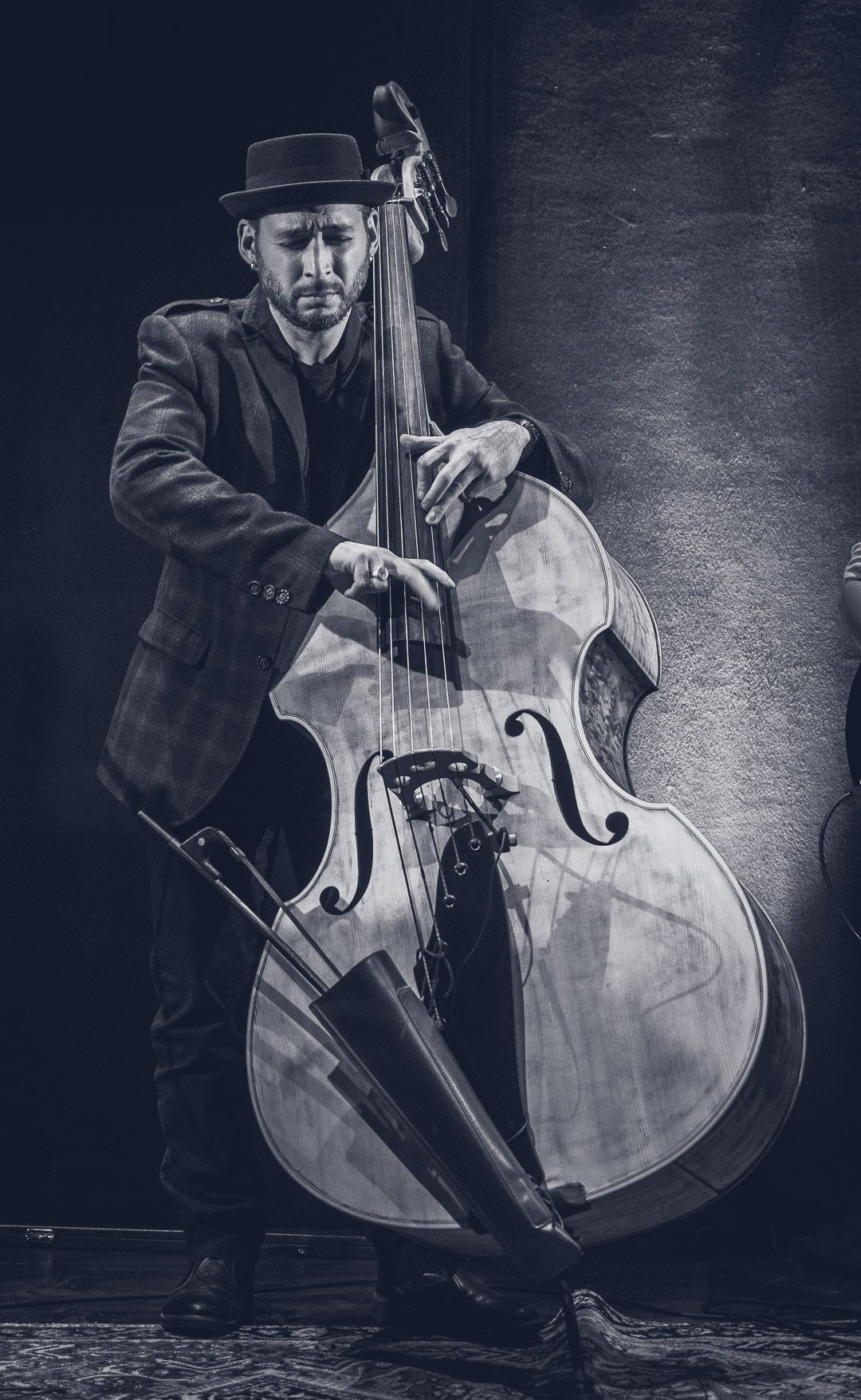
In this process, the double bass is my privileged point of observation.
It is an instrument that can stand at the foundation of the music without being confined to a secondary role. It can support, accompany, create movement, but also sing and take the lead. Its relationship with rhythm, harmony and melody reflects the way I understand music: not necessarily to occupy the centre, but to create connections between what happens around it.
I believe music must remain a concrete experience.
It can be complex, refined and deeply structured, but it must not lose its physical dimension. It has to be able to make you move, to move you, to stir curiosity, to create tension or simply to accompany a moment of life.
Before being analysed, music must be listened to. Before being explained, it must be allowed to happen.
I look for music that is alive.
Music that can hold memory without becoming nostalgic, research without becoming abstract, tradition without becoming imitation. Music able to cross cultures and languages while keeping its own identity.
This is the direction I want to keep exploring:
to compose, to meet, to listen and to transform.
To cross places and traditions not to collect them, but to let myself be changed by what I encounter.